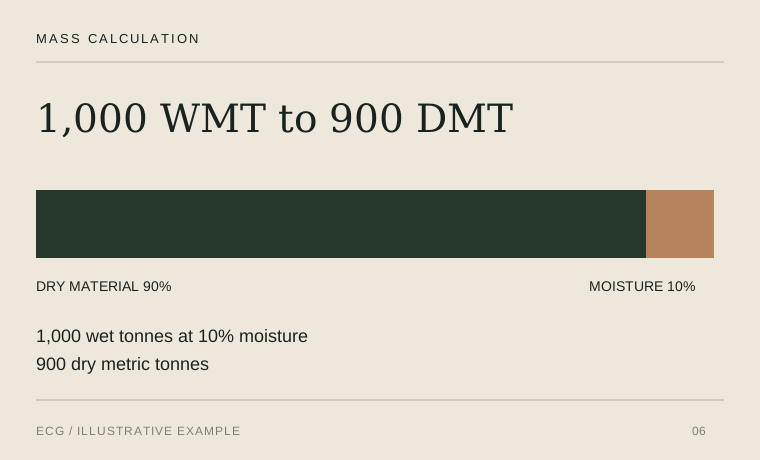
For moisture measured as a percentage of wet mass, DMT = WMT × (1 − moisture ÷ 100). At 10% moisture, 1,000 WMT gives 900 DMT.
An offer priced per wet metric tonne cannot be compared directly with one priced per dry metric tonne. First establish the moisture basis, then convert both quantities to the same unit.
The worked examples below use moisture as a percentage of wet mass. Applying them to a shipment requires a representative moisture result for the same lot as the weight record. SGS’s sampling guidance describes the importance of representative material for testing. [1]
Write down the basis
A wet metric tonne includes the moisture present in the material. A dry metric tonne expresses the mass after excluding that moisture on the agreed basis. Contracts should spell out the basis rather than expecting everyone to infer it from a price sheet.
For this article, moisture percentage is the mass of moisture as a percentage of the wet mass. The examples assume that the moisture result is representative of the same lot as the recorded wet weight. They do not prescribe a testing method.
Calculate dry tonnes
Dry metric tonnes = wet metric tonnes × (1 − moisture percentage ÷ 100).
For example, 1,000 wet metric tonnes at 10% moisture contain 900 dry metric tonnes. At 5% moisture, the same 1,000 wet tonnes contain 950 dry tonnes. Those are illustrative quantities, not ECG inventory figures.
A calculator should reject negative weights and moisture outside its permitted range. It should display the inputs and units beside the answer, so the result can be checked rather than copied without context.
Keep the grade basis consistent
When a grade is expressed on a dry basis, apply it to dry tonnes to estimate contained material. In a simplified example, 900 dry tonnes at a dry-basis grade of 20% contain 180 tonnes of the stated component.
This is a mass calculation, not a prediction of metal recovery or a statement of payable metal. Recoveries, deductions, product specifications and contractual payability are separate inputs. Keep them separate in a commercial model.
Compare the same commercial unit
Suppose an illustrative offer is USD 100 per wet tonne at 10% moisture. Ignoring all other costs, the equivalent cost per dry tonne is USD 100 ÷ 0.90, approximately USD 111.11. That conversion does not establish a market price or determine whether the offer is attractive.
For a fair comparison, use the same delivery point and include transaction-specific costs. Testing, handling, transport and contractual quality adjustments may differ. A single converted unit price is a starting point, not a complete landed-cost model.
Agree when and how moisture is measured
Discuss the sampling location, timing, method and retained-sample procedure with the independent inspector and relevant technical advisers. Identify how wet mass and moisture records will be linked to the same lot.
Ask how exposure, storage or movement between sampling and weighing will be treated. Avoid silently combining a weight from one date with a moisture result from an unrelated sample. Where a procedure has limitations, record them.
Reconcile the settlement quantity
Include a quantity reconciliation in the transaction file: wet mass, moisture result, calculated dry mass and any subsequent settlement adjustments. Keep the original weight and laboratory references beside the calculation.
The calculator in ECG’s resource section applies these formulas. Check its output against the original weight and moisture records, and carry the relevant report references into the transaction file. The result is a mass calculation; settlement still follows the agreed inspection and commercial terms.
References
The linked sources support the referenced information. Checklists and review questions are ECG’s editorial suggestions. This article provides general information, not advice on a particular transaction. External references do not imply an affiliation or endorsement.
Preparing a purchase or project enquiry?
The resource page includes templates for buyer requirements, source checks and project introductions.
View the templates